HALPI2 vs a Raspberry Pi plus SH-RPi: Which Boat Computer?
7 min read
On this page
You want a computer on the boat to run Signal K, charting software or a data logger. Hat Labs makes two products for this job. The HALPI2 is a finished marine computer. The SH-RPi is a power board that turns a Raspberry Pi you supply into a boat computer.
They solve different problems. This guide compares them so you can decide before you add up the parts.
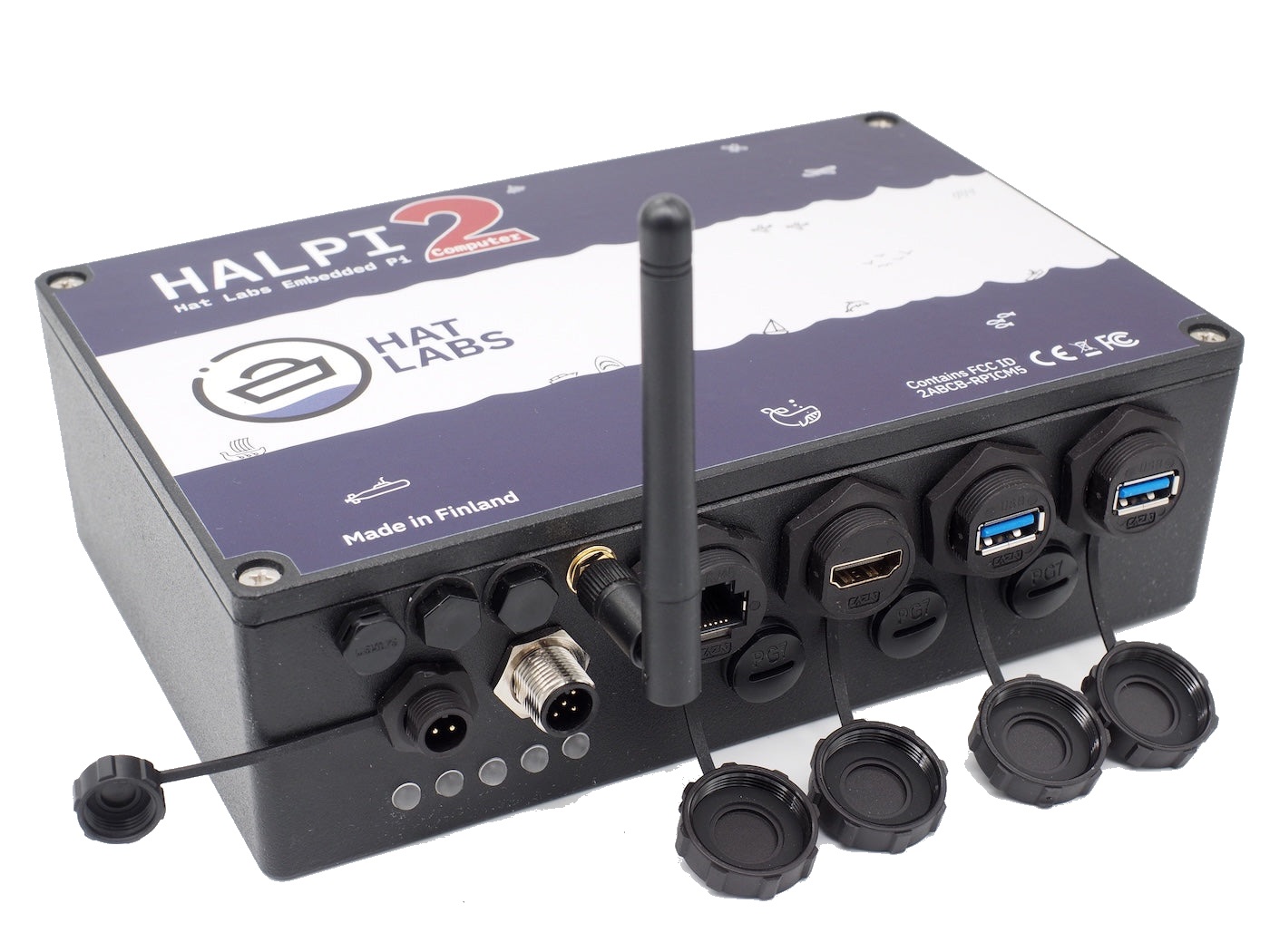 View full size (opens in a new tab)
HALPI2. Product photo by Hat Labs.
At a glance
| HALPI2 | Raspberry Pi + SH-RPi | |
|---|---|---|
| What you get | Complete computer in an IP65 case | Power HAT only. You supply the Pi, case and storage |
| Computer | Compute Module 5 | Any Pi with a 40-pin header |
| Storage | M.2 NVMe SSD | Whatever your Pi uses |
| Input voltage | 10-32 V | 9-32 V (under 10 V counts as undervoltage) |
| Input current limit | 0.9 A or 2.5 A, set by a switch | 0.8 A, or 1.8 A or 2.8 A with jumpers |
| Backup at power loss | Supercapacitors, 30-60 s at load | Supercapacitors, up to 70 s on a Pi 4B, by load |
| Real-time clock | Yes, CR2032 battery holder | Yes, CR1220 battery holder |
| NMEA 2000 | Built in, Micro-C, isolated | Not included. Add a CAN HAT |
| NMEA 0183 | Built-in isolated RS-485 port | Not included. Add an RS-485 HAT |
| Waterproofing | IP65 case | None. Put it in a waterproof enclosure |
Sources: HALPI2 hardware reference, HALPI2 power supply, SH-RPi hardware.
HALPI2: the finished computer
HALPI2 is a Raspberry Pi Compute Module 5 on a Hat Labs carrier board. It sits in a powder-coated aluminium case, 200 x 130 x 60 mm, rated IP65. The case is the heat sink, so there is no fan (hardware reference). The 4 GB / 256 GB version has an NVMe SSD in the board's M.2 slot.
On the panel you get a power connector, an NMEA 2000 Micro-C connector, Gigabit Ethernet, HDMI and two USB 3.0 ports. The board has two more USB 3.0 ports inside. The panel also has blind plugs for antennas and cable glands (hardware guide).
Already on the board:
- Power input. 10-32 V, with reverse-polarity protection and protection against transients up to 100 V, such as alternator load dumps.
- Safe shutdown. Supercapacitors carry the computer for 30-60 seconds after power is cut, long enough for a clean shutdown. It is not a UPS (FAQ).
- NMEA 2000. An isolated CAN FD interface that runs as
can0on Linux (interfaces guide). - NMEA 0183. An isolated RS-485 interface, wired for NMEA 0183. It has no panel connector. You add a cable gland or panel connector yourself.
- HAT support. A standard 40-pin header with room for up to two stacked HATs. A HAT must fit a 65 x 56 mm footprint, and one with connectors on the supercapacitor side may not fit. Some pins and the I2C address 0x6d are used by the board, so check a HAT before you buy it (hardware guide).
Raspberry Pi plus SH-RPi: build your own
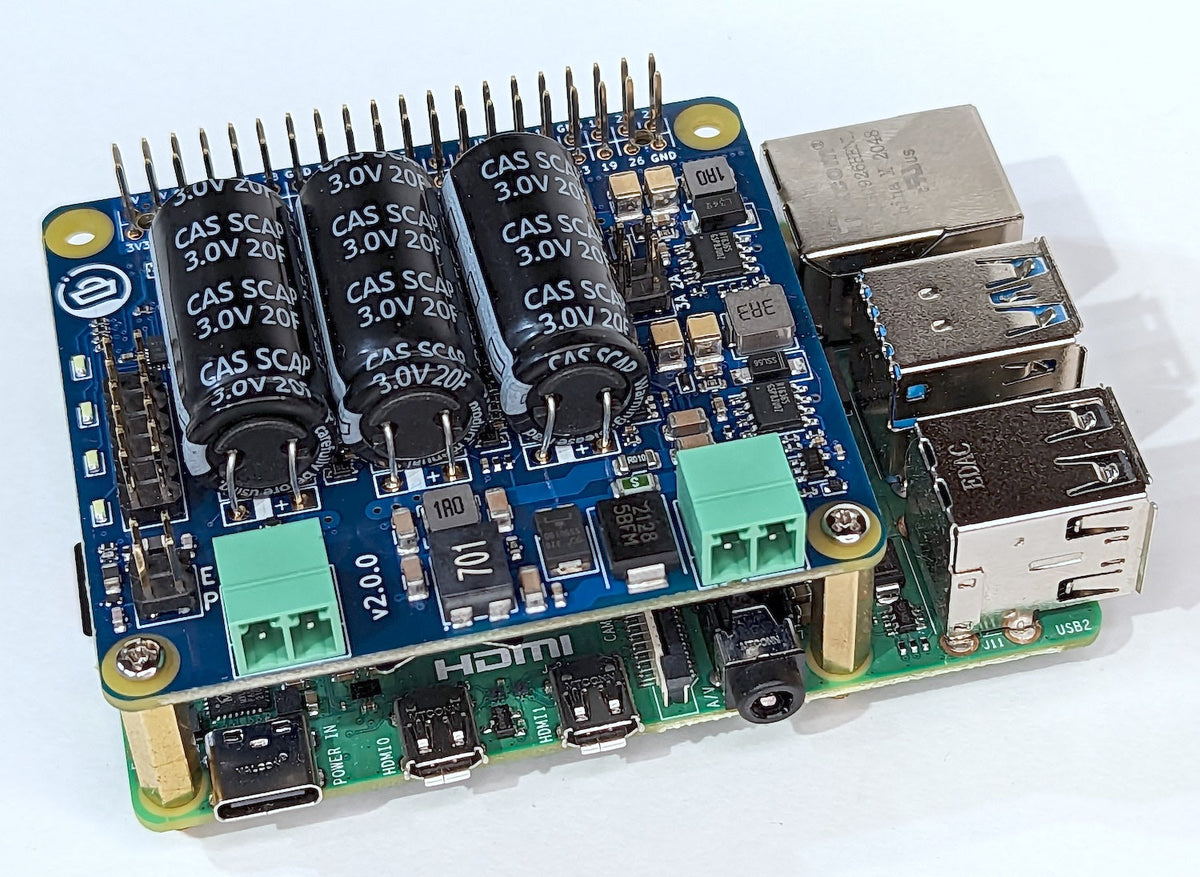 View full size (opens in a new tab)
SH-RPi on a Raspberry Pi. Product photo by Hat Labs.
The SH-RPi is a power HAT. It sits on a Raspberry Pi and connects it to the boat's 12 V or 24 V supply. Version 2 takes 9-32 V and has a 4 A fuse, a transient suppressor and reverse-polarity protection. Hat Labs treats anything under 10 V as undervoltage. Three 20 F supercapacitors hold the 5 V supply up when input power drops, so the Pi can shut down cleanly. It also has a real-time clock that can wake the Pi on a schedule, and a watchdog that reboots a Pi that stops responding (hardware page).
It stacks through the Pi's 40-pin header, and other HATs go on top. It does not put data on NMEA 2000. Version 1 had an NMEA 2000 interface. Version 2 dropped it (revisions).
Which Pi? Hat Labs says the SH-RPi supports every Raspberry Pi with a 40-pin header (docs). Its documentation uses the Pi 4B as the example. The board's 5 V output peaks at 5 A. Sustained output is about 1.4 A at the default 0.8 A input limit, and at least 3 A in open air at room temperature with the 2.8 A jumper, which needs a separate feed rather than the NMEA 2000 bus. Raspberry Pi's power supply guidance recommends a 5 A supply for the Pi 5 and 3 A for the Pi 4 Model B. It also limits a Pi 5's USB output to 600 mA unless the supply can deliver 5 A.
What you still need to buy
- A Raspberry Pi with a 40-pin header.
- Storage: a microSD card or an SSD, depending on the Pi.
- A waterproof enclosure. Hat Labs says to put the Pi and SH-RPi in one for a boat or any condensing environment (getting started). See Accessories.
- A fused 12 V or 24 V feed, and wire.
- An NMEA 2000 interface if you want bus data. Hat Labs documents an isolated CAN HAT for this (CAN HAT page).
- An RS-485 HAT if you want NMEA 0183 (RS-485 HAT page).
- A drop cable and T-connector for NMEA 2000, if you do not already have them.
Power and NMEA 2000 load
Both can run from the NMEA 2000 bus. Both limit their input current to stay inside what a bus node should draw.
- HALPI2 has a 0.9 A limit by default. That is a Load Equivalency Number of 18, and Hat Labs says to connect it close to the power feed. Powered from its own connector, it draws nothing from the bus. To power it from the bus you open the case, swap an internal terminal block and keep the limit at 0.9 A (interfaces guide, getting started).
- SH-RPi limits input to 0.8 A by default. At that setting the 5 V output sustains about 1.4 A. The 1.8 A and 2.8 A jumpers raise the limit for a separate feed (hardware page). Hat Labs notes that NMEA 2000 caps a single node at 1.0 A, and documents wiring bus power to the SH-RPi through a CAN HAT.
HALPI2 draws about 250 mA idle and up to about 590 mA under load at 12 V, with a headless HaLOS image, not counting USB devices (hardware reference). For the SH-RPi route, add up your Pi, SSD, HAT and USB devices against the 1.4 A figure.
HALPI2 reserves I2C address 0x6d for its own controller, and the SH-RPi also uses 0x6d, so the two cannot share a bus. HALPI2 already has this power management built in.
Software
HALPI2. HALPI2 ships with HaLOS (getting started). Its Marine variants include Signal K, Grafana, InfluxDB and AvNav. HALPI2 images also come for OpenPlotter, Raspberry Pi OS and Raspberry Pi OS Lite. All of them have the CAN and RS-485 interfaces set up (software guide).
Pi plus SH-RPi. Hat Labs provides an install script for the SH-RPi daemon. It was tested on a freshly flashed Raspberry Pi OS, and Hat Labs says it has not been tested on other systems (getting started). The daemon handles shutdown on power loss and the watchdog. HaLOS also has generic images for the Pi 4 and 5, but those carry no hardware-specific drivers (choosing an image).
Which one
Choose HALPI2 if you want one sealed unit with NMEA 2000 and NMEA 0183 interfaces, storage and an enclosure already done.
Choose a Pi and SH-RPi if you already own a Pi, want a different Pi model, or want to fit your own enclosure. It also suits a small Signal K node that only needs boat power and a safe shutdown. Budget for the CAN HAT, storage and enclosure if you want the rest.
Choose neither if you only need sensor data on the network. An ESP32 board does that without a Linux computer. See Development Boards.
For where these fit in a full Signal K setup, see Signal K hardware: what you need. Browse Marine Computers and NMEA 2000 for the connecting parts.
US stock. Ships from the US.
Products in this guide
This document was last updated in November 2026.