SH-ESP32 vs HALMET: Which Hat Labs Board for Your Boat
6 min read
On this page
Hat Labs makes two ESP32 boards for boats. Both have Wi-Fi, Bluetooth and an NMEA 2000 interface, and both are development boards you program yourself. They are built for different jobs, and the wrong pick means extra parts or a board that cannot read your sender.
This guide compares the SH-ESP32 and the HALMET on what decides the choice: what you can connect, how each is powered and protected, and what you still have to buy and write.
The short version
- HALMET is for engine and tank senders: resistive senders, voltage signals, alarm switches and RPM pulses. The inputs are isolated from the ESP32.
- SH-ESP32 is the general-purpose board: an isolated NMEA 2000 interface, one optocoupler input and output, 1-Wire, I2C, and every ESP32 pin on a header. It has no protected analog input.
Side by side
| SH-ESP32 | HALMET | |
|---|---|---|
| Built for | Gateways, custom Signal K nodes, relay control, 1-Wire and I2C sensors | Engine and tank senders |
| Supply | 8-32 V | 5-32 V |
| Analog inputs | No protected input. The ESP32's own ADC pins are on the GPIO header | 4, 16-bit, 0-33 V. A jumper adds a 10 mA source for resistance up to about 300 ohms |
| Digital inputs | 1 optocoupler input, about 2.5-18 V | 4 inputs, up to plus or minus 32 V |
| Outputs | 1 optocoupler output, can drive a small automotive relay | None. Use free GPIO pins |
| Isolation | Isolated CAN interface. Optocoupler input and output | Analog and digital inputs isolated from the ESP32 |
| 1-Wire and I2C | Both, protected, headers fitted | Both. The 1-Wire header is not fitted, and the I2C header is not isolated |
| GPIO | All ESP32 pins on a header, unprotected | 13 free GPIO pins. The header is not fitted, so you solder it on |
| Flash | 4 MB | 16 MB |
| Programming | Micro-USB | Micro-USB |
Sources: SH-ESP32 hardware docs, SH-ESP32 hardware repository, HALMET docs, HALMET hardware docs and HALMET usage docs.
SH-ESP32
 View full size (opens in a new tab)
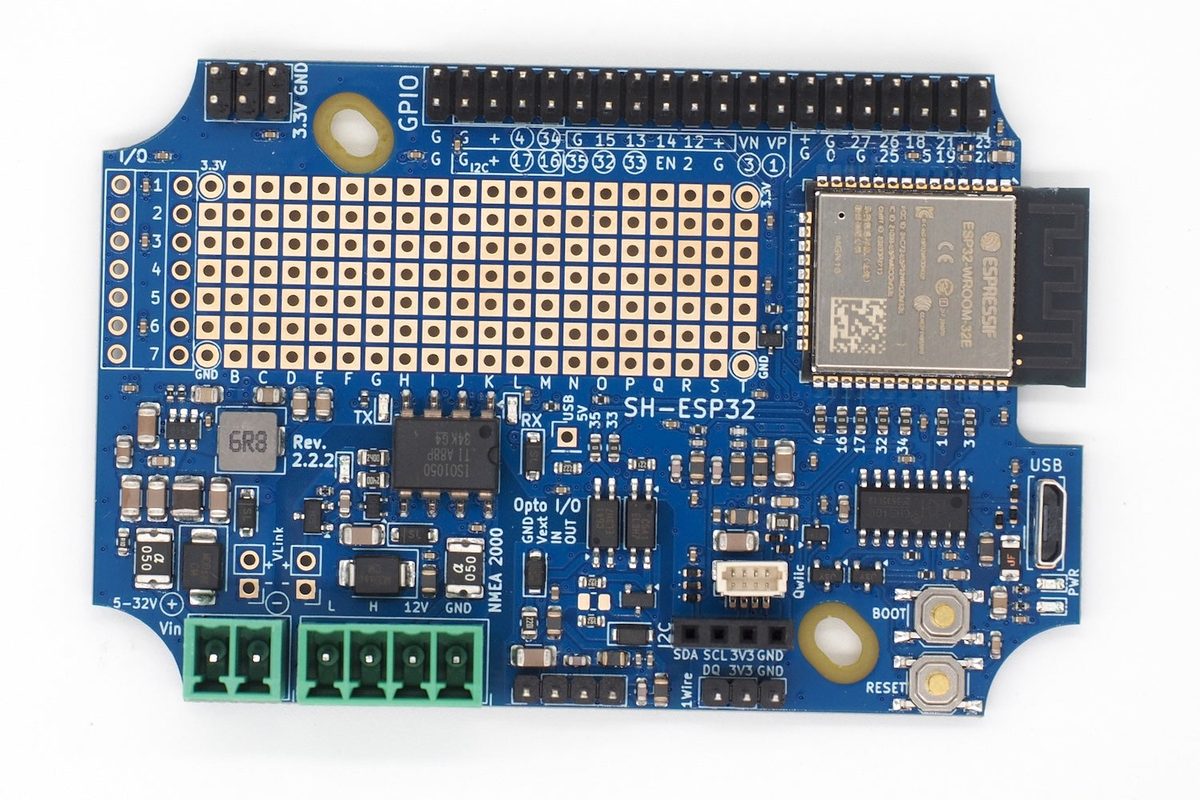
SH-ESP32. Photo: Hat Labs.
The SH-ESP32 is a blank, well-protected ESP32 board. The supply takes 8-32 V, so it runs on 12 V and 24 V boats, and the power input has reverse-polarity and surge protection (hardware docs). The NMEA 2000 interface is isolated, and Hat Labs documents an NMEA 2000 USB gateway built from the board and a few connectors.
For a pulse signal such as alternator RPM, Hat Labs points to the optocoupler input. Its absolute maximum is 18 V, which you can raise with a series resistor. If your tachometer signal runs higher than that, plan for it. The optocoupler output can switch small automotive relays. The 1-Wire header is a simple way to add temperature probes.
What it lacks is a protected analog input. The GPIO header exposes the ESP32 pins with no ESD or noise protection, as Hat Labs notes. Reading a resistive oil pressure or tank sender means adding your own circuit, for example an I2C analog converter, and that circuit is yours to design.
The package includes the rev. 2 board with connectors soldered and pluggable screw terminals for CAN and power (Hat Labs getting started). On Mac and Windows, the board's CH340 USB chip needs a driver from its maker (hardware docs).
HALMET
 View full size (opens in a new tab)
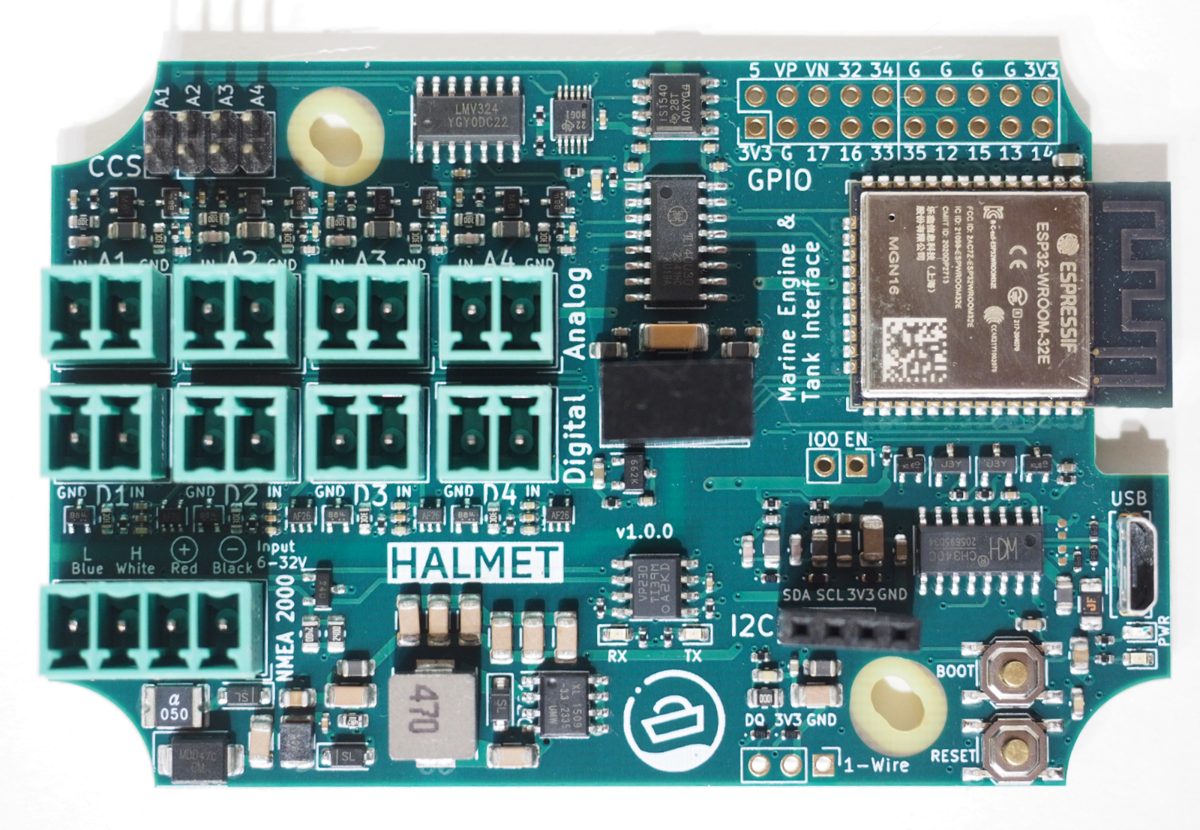
HALMET, top view. Photo: Hat Labs.
HALMET exists to read the signals on an engine and in a tank. It has four analog inputs and four digital inputs, and all eight are galvanically isolated from the ESP32. That is why the board can take its power from the NMEA 2000 network without creating a ground loop (hardware docs).
An analog input measures voltage. That is how you read a resistive sender while the original gauge stays connected, because the gauge and sender form a voltage divider. With no gauge, a jumper turns on a 10 mA current source and the input measures the sender's resistance, up to about 300 ohms (usage docs). The digital inputs read alarm switches and count pulses for RPM, fuel flow or a chain counter. The wiring and calibration steps are in Analog Engine Data to NMEA 2000 with HALMET.
Hat Labs says HALMET stays within the NMEA 2000 standard only while its unisolated connectors are not tied to other grounded devices. A long 1-Wire sensor cable is fine. An I2C analog converter on the I2C header would break it (hardware docs). Do not close the CAN terminator jumper on an NMEA 2000 network.
The sales package has the board, a 4-pin terminal for NMEA 2000 and power, eight 2-pin input terminals and four jumpers for resistance measurement (getting started).
Which one to buy
| You want to | Choose |
|---|---|
| Read oil pressure, coolant temperature or a tank level from resistive senders | HALMET |
| Read engine alarm switches and an RPM pulse on isolated inputs | HALMET |
| Build an NMEA 2000 gateway or a custom Signal K node | SH-ESP32 |
| Switch a relay, such as a blower | SH-ESP32 |
| Add 1-Wire temperature probes or an I2C sensor and little else | SH-ESP32 |
| Count pulses from a sensor such as a paddlewheel log | Either. HALMET inputs take up to 32 V and the SH-ESP32 opto input up to 18 V. The SH-ESP32 version is in VDO Sumlog Sensor to Signal K |
Some boats need both, for example an engine with senders plus a relay. They can sit on the same NMEA 2000 network as two devices.
If you want a finished marine computer that runs Signal K out of the box, neither board is it. That is HALPI2, under Marine Computers.
What you still need
Neither board has software installed. Hat Labs says so for both (SH-ESP32 getting started, HALMET usage docs). You load firmware over USB, so a computer and a USB cable are part of the job.
SensESP, the Signal K sensor framework, is the usual path on both. Its getting started guide covers the tools.
- HALMET: Hat Labs maintains the HALMET example firmware. By default it reads engine RPM on D1, a fuel level on A1 and a low oil pressure alarm on D2, and you edit it for your inputs. HALMET's pins differ from other ESP32 boards, so start from this example rather than other code (usage docs).
- SH-ESP32: Hat Labs recommends SensESP with Visual Studio Code and PlatformIO (software docs). There is no ready-made firmware for your sensors, so you write the code. The VDO Sumlog guide has a worked SensESP example.
Around the board, you will also want:
- An NMEA 2000 backbone with power and two terminators, if you connect to one. See NMEA 2000.
- A waterproof enclosure and a panel connector or pigtail for the NMEA 2000 side. See Accessories. Hat Labs says both boards belong in an enclosure on a boat, and recommends a larger one for HALMET if you use more than a few inputs (SH-ESP32 getting started, HALMET getting started).
- The data sheet for each sender. Hat Labs documents the boards, not your engine, so check a sender's electrical specs before you connect it.
New to the whole setup? The Signal K hardware page shows how a host, a board and the network fit together.
Products in this guide
This document was last updated in November 2026.